

REST APIs
REST is an architectural style or design pattern for APIs. When a client request is made through a RESTful API, it transfers a representation of the state of the requested resource. Web services that follow the REST architectural style are called RESTful web services. A RESTful web application exposes information in the form of information about its resources. It also enables the client to take actions on those resources, such as creating new resources (for example, creating a new user) or changing existing resources (for example, editing a post).Resources
A resource is any piece of data that an API can provide, modify, or interact with. It represents an entity or object, such as a customer, payment, order, invoice, or refund. Each resource is identified by a unique URL (endpoint) and is typically manipulated using HTTP methods.HTTP Methods
HTTP defines a set of request methods, also known as HTTP verbs, to indicate the desired action for a given resource. Given below is the list of methods commonly adopted by Razorpay APIs:Example
Example
Use the Razorpay Payments API to fetch specific payment (the resource) details. The API response returns the payment state, including payment amount, currency, payment method and more. The representation of the state can be in a JSON format.
GET /payments/:idResponse
HTTPS Status Codes
HTTP response status codes indicate whether a specific HTTP request is successfully completed. Responses are grouped into five classes:- Informational responses (100–199)
- Successful responses (200–299)
- Redirection messages (300–399)
- Client error responses (400–499)
- Server error responses (500–599)
Success Responses
Success Responses
Given below is the list of the most commonly encountered success responses:
Error Responses
Error Responses
Following is the list of the most commonly encountered error responses:
Parameter Types
Following table lists the various parameter types with examples:
The following images highlight the different types of API parameters.
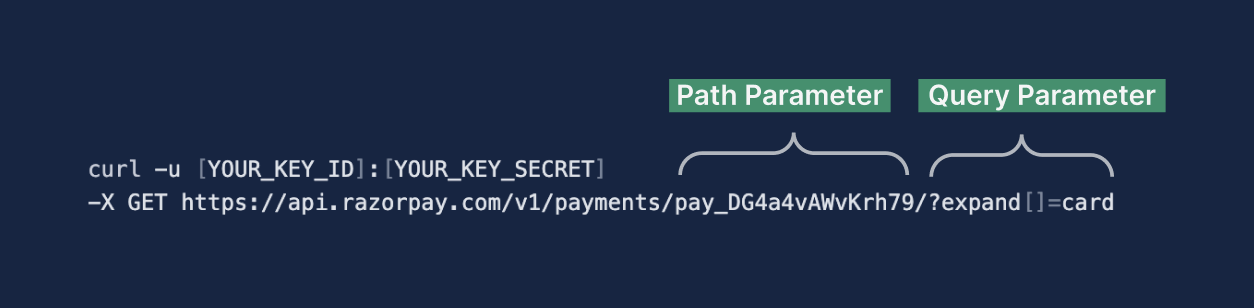
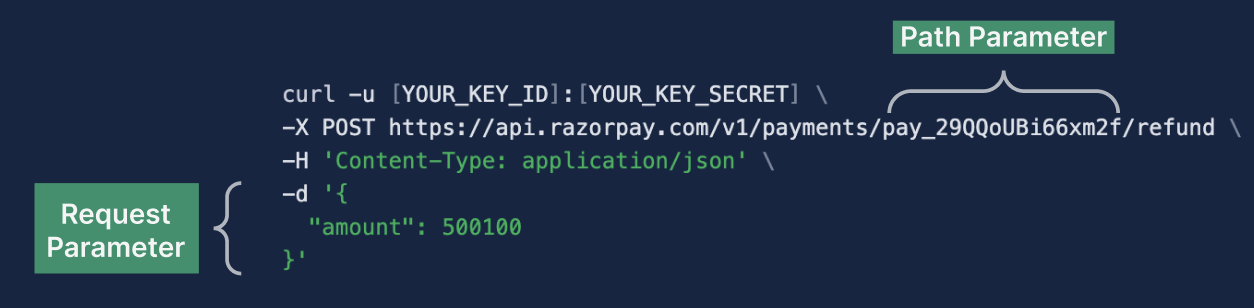
Data Types
Razorpay APIs use standard data types to represent different kinds of information in API requests and responses. The following table outlines the primary data types used:Conventions
Following are some conventions followed in Razorpay APIs:Entity
All Razorpay API responses carry this attribute with the value being the name of the API resource. For example,"entity: "order". There are some common attributes for every entity.
entity
: string Indicates the type of the entity.
id
: integer A unique identifier of the entity.
In an entity, the attributes can be used to make entity-specific API calls. For example, you can fetch the payment ID from the order.paid webhook and use it to initiate a refund for that payment.
Collection
A list of objects/entities is called collection. Usually, when fetching an API resource using the GET method, multiple entities are expected in the result. In this case, it is returned in a collection form. For thecollection entity, the following parameters are common.
entity
: string Indicates the type of the entity. For example, collection.
count
: integer Indicates the number of items are returned. For example, 2.
items
: array The list of entities.
Notes
Thenotes object is a set of key-value pairs that can be used to store additional information about the entity. It can hold a maximum of 15 key-value pairs, each 256 characters long (maximum).
The majority of the entities allow the notes object to store additional information and preserve data relevant to your integration. Razorpay does not use it for any operational purposes.
You can store the notes related to:
- Billing or shipping address of the initiated payment.
- Reference id generated for an order.
Identifier
Razorpay attributes are uniquely identified by their identifier which is mostly present in the attributeid. The identifier is of 14 characters, alphanumeric and case-sensitive.
Response Body
When you make a request to the Razorpay API, the server responds with a JSON object containing relevant data. The response body structure varies depending on the API endpoint and the type of request.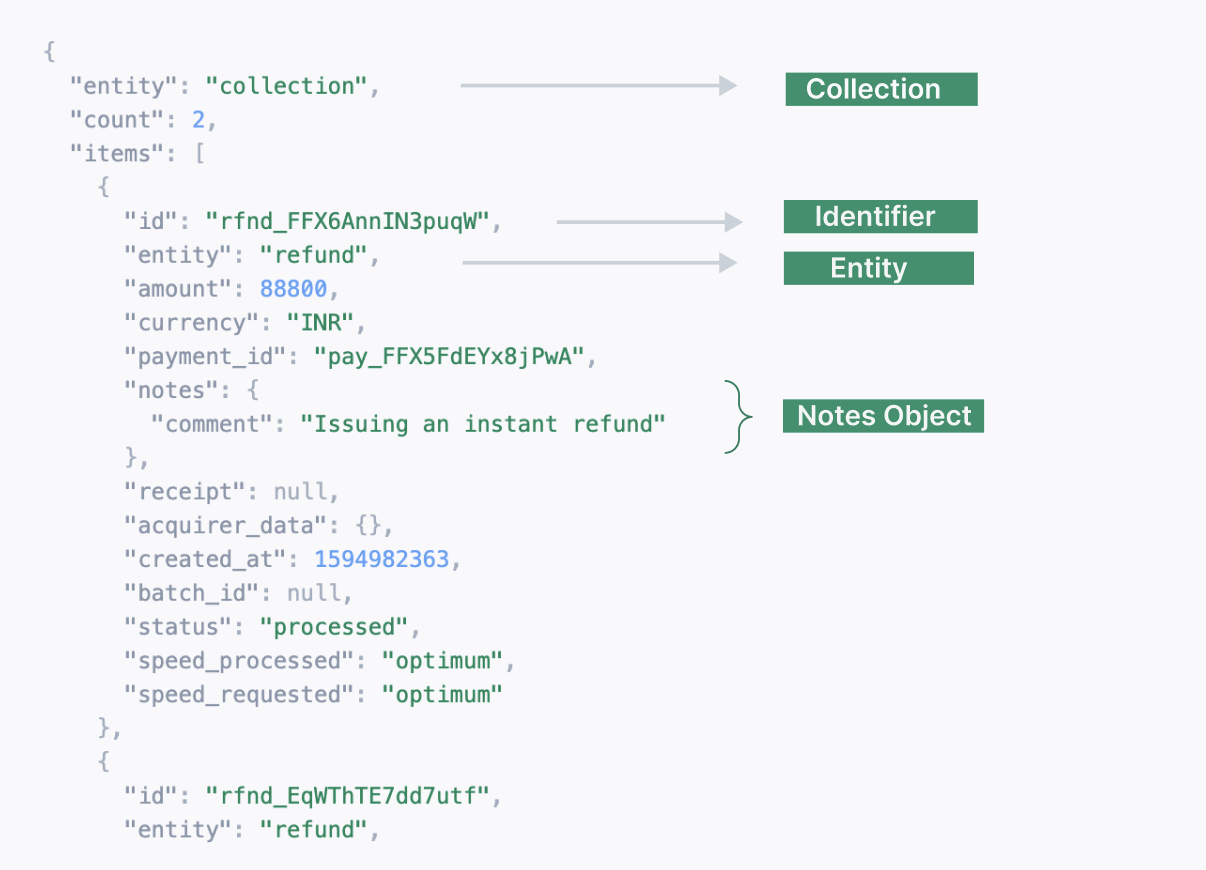
Versioning
All Razorpay APIs are backwards-compatible. If an API or its parameters are deprecated, we add a warning note for the same for a specific period of time.Rate Limiting
Razorpay uses a request Rate Limiter to limit the number of requests received by the API within a time frame. Rate Limiter helps maintain system stability during heavy traffic loads.- While integrating with any APIs, watch for HTTP status code 429 and build the retry mechanism based on the requirement.
- Use an exponential backoff/stepped backoff strategy to reduce request volume and stay within the limit.
- Add some randomisation within the backoff schedule to avoid the thundering herd effect.
Pagination
Usually, when you make calls to the Razorpay APIs, there will be a large volume of responses. You can paginate the results to ensure that these responses are easier to handle, using a combination of the query parameters given below to receive a specific number of records in the API response.from
: integer Timestamp, in Unix, after which the entities are created.
to
: integer Timestamp, in Unix, before which the entities are created.
count
: integer Number of entities to fetch. Default is 10. This can be used for pagination, in combination with skip.
skip
: integer Number of entities to skip. Default is 0. This can be used for pagination, in combination with count.
Example
Example
If you want to get information on all the payments received from customers, the result could be a massive response with hundreds of payments.